

Reading time: 5 minutes. Author: Hugo S. Nascimento.
Most enterprise AI pilots collapse before production. Not because foundation models lack intelligence, but because teams lack engineering specifications.
Teams build brittle demos powered by free-form system prompts. Once the agent meets legacy relational databases, zero-tolerance financial workflows, and undocumented enterprise policies, the deployment fails.
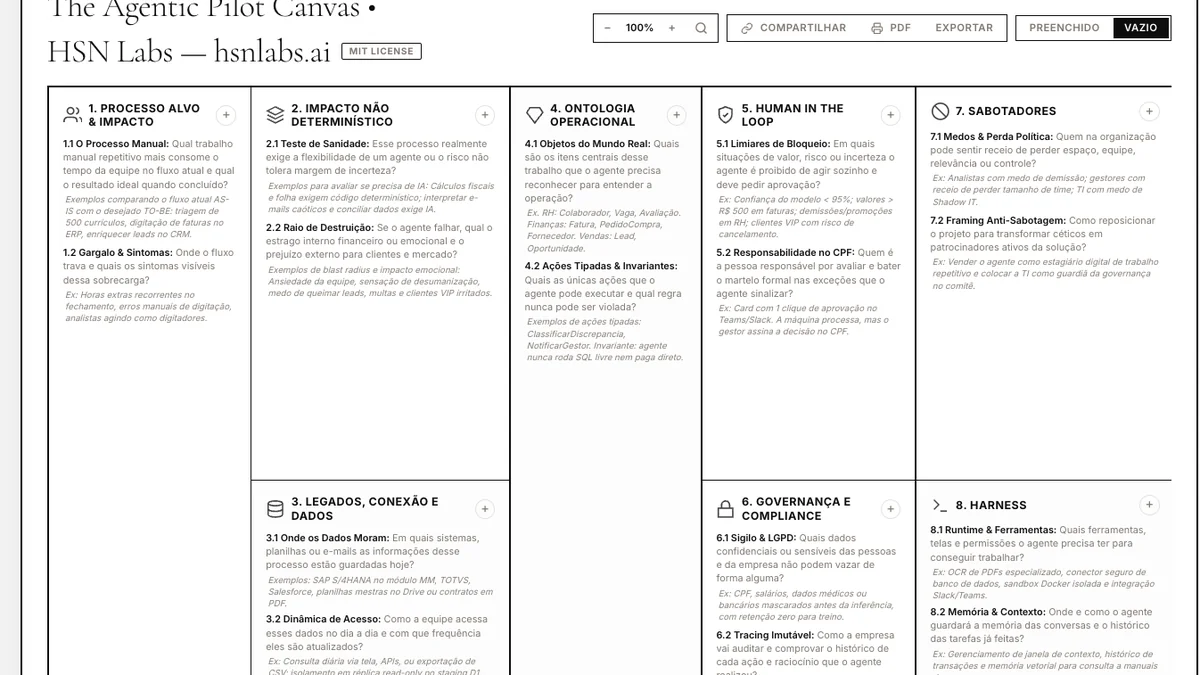
To solve this architectural gap before committing code, I designed and released The Agentic Canvas™.
Version 1.5, updated in October 2026, codifies the production lessons from our engineering sprints at hsnlabs. The framework runs natively in the browser:
👉 Launch interactive canvas: hsnlabs.ai/canvas
The Dependency Chain
An enterprise pilot never starts with model selection. It follows a deterministic ten-stage sequence:
flowchart LR
    P1["1. Target Process"] --> P2["2. Non-Determinism"]
    P2 --> P3["3. Legacy Data"]
    P3 --> P4["4. Operational Ontology"]
    P4 --> P5["5. Human in the Loop"]
    P4 --> P6["6. Governance & Compliance"]
    P5 --> P7["7. Saboteurs"]
    P6 --> P8["8. Evaluation Harness"]
    P7 --> P9["9. Financial ROI"]
    P8 --> P9
    P9 --> P10["10. Production Rollout"]
[Agentes] x [a Gente] — Beyond the hype: how agentic engineering multiplies and leverages human labor capacity. Bi-weekly field notes published in Hugo S. Nascimento's LinkedIn newsletter with over 1,600 subscribers. Follow on LinkedIn ↗
The 10 Blocks of the Framework
- Target Process & Impact: Pinpoint the repetitive manual bottleneck. Keep pilots strictly internal.
- Non-Deterministic Impact: Verify whether the workflow demands stochastic inference or deterministic code. Define blast radius boundaries.
- Legacy Systems & Data: Map where state lives — SAP, TOTVS, Salesforce, or master spreadsheets. Reverse engineer legacy rules into typed specifications.
- Operational Ontology: Declare real-world domain objects and strongly-typed actions. The agent never executes raw SQL.
- Human in the Loop: Enforce formal approval thresholds for high-risk mutations.
- Governance & Compliance: Anonymize PII prior to inference and record immutable OpenTelemetry traces.
- Saboteurs & Organizational Alignment: Mitigate political friction by framing agents as digital apprentices handling low-level toil.
- Evaluation Harness: Run automated regression suites against hundreds of benchmark scenarios before release.
- Financial ROI: Prove net margin expansion on the P&L after factoring token consumption and infrastructure overhead.
- Rollout Trigger: Define explicit five-day sandbox gates that unlock production deployment upon reaching agreed accuracy thresholds.
Interactive Tooling
The framework includes: * Blank Mode: Clean sheet for live executive scoping workshops. * Filled Benchmark: Production case study integrated into legacy enterprise systems. * Tooling: Local browser persistence, presentation loupe, and one-click PDF export.
Open the tool at hsnlabs.ai/canvas to architect your next production agent.
Article originally published on hsnlabs. Author: Hugo S. Nascimento.