An open decentralized coordination protocol (HACP-RFC-0001) that replaces quadratic point-to-point natural language agent chatter with durable, strongly-typed graph pheromones, dynamic capability handshakes, and pre-inference atomic idempotency locks on SQLite WAL.
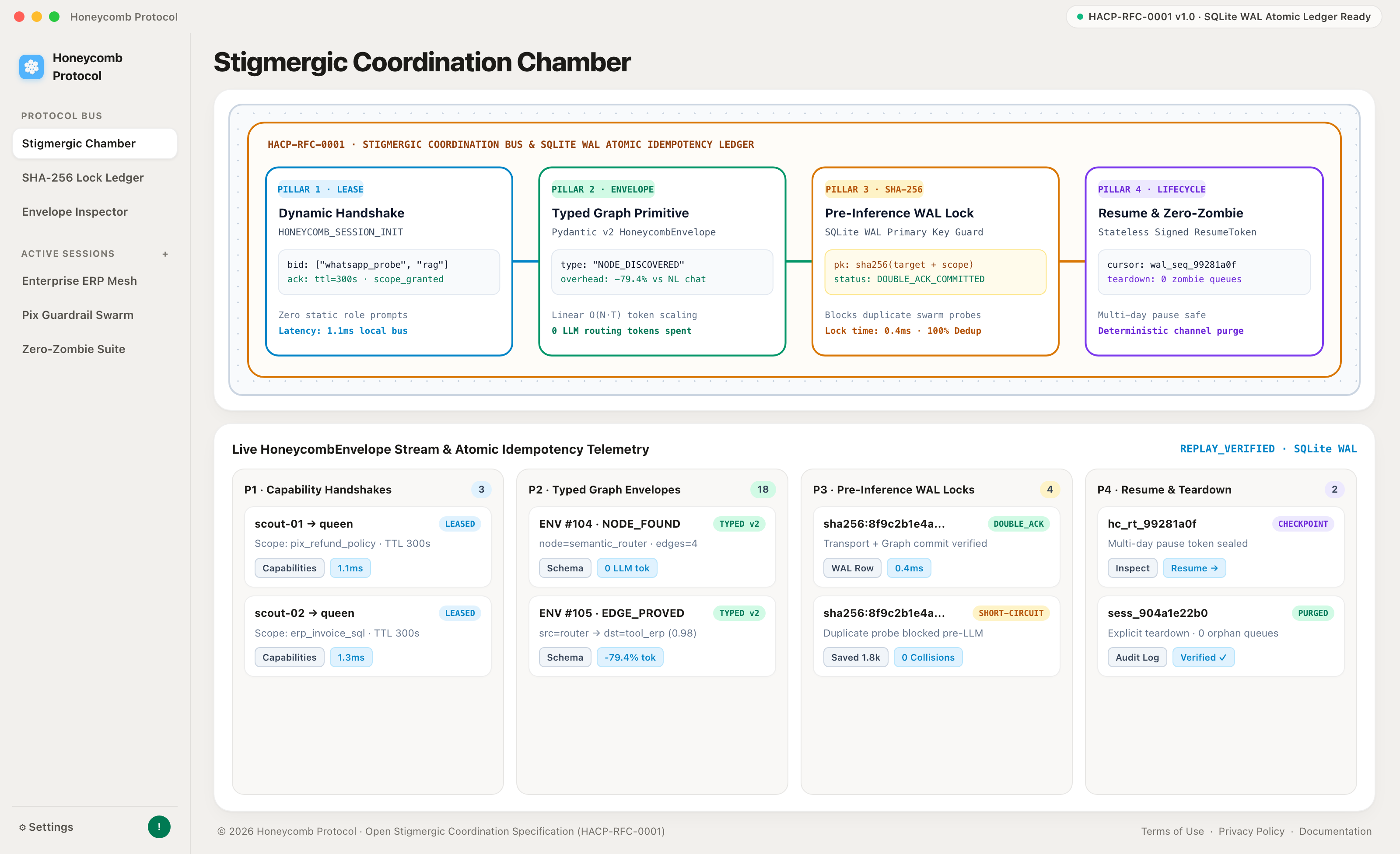
Engineered under HACP-RFC-0001 to eliminate destructive race conditions, quadratic token burn, operational amnesia, and zombie subscriber channels in long-horizon swarms.
Establishes mutual verification before task execution. Agents advertise active capabilities via HONEYCOMB_SESSION_INIT and receive scoped lease authorizations with bounded TTL via HONEYCOMB_HANDSHAKE_ACK·eliminating rigid, hardcoded agent roles.
Enforces strict Pydantic v2 separation between causal routing headers (correlation_id, target_scope_hash, ttl_seconds) and universal graph primitives (node_id, typed edges, confidence_score) paired with an open properties dictionary for raw target telemetry.
Blocks duplicate work before any LLM call by claiming deterministic SHA-256 target_scope_hash locks in the SQLite WAL honeycomb_idempotency_keys ledger, committing discoveries only after two-phase HONEYCOMB_DOUBLE_ACK verification (transport + semantic graph).
Operates via asynchronous logical sessions backed by integrity-signed continuation tokens (hcrt1) that survive multi-day quota freezes, while requiring explicit HONEYCOMB_SESSION_TEARDOWN handshakes to drain queues and prevent zombie channels.
Formal mathematical guarantees of stigmergic graph coordination compared against conversational group-chat meshes and vertical tool-binding protocols.
In conversational multi-agent frameworks, every peer message is appended to a shared natural language transcript, driving O(N² · T) token growth. Honeycomb replaces peer-to-peer dialogue with O(1) stigmergic graph mutations and atomic pre-inference locks.
Honeycomb does not compete with low-level RPC transports or single-agent tool protocols. It occupies the semantic decentralized coordination layer for multi-agent swarms.
Reference implementation modules engineered for sub-10ms local reflex routing, transactional auditability, and multi-day fault tolerance.
Dedicated honeycomb_idempotency_keys table indexed by SHA-256 target_scope_hash primary keys, tracking claiming agent ID, lock status (CLAIMED / COMPLETED), and TTL expiration.
Asynchronous in-memory event bus routing session handshakes, capability leases, and stigmergic digital pheromones with sub-10ms dispatch latency.
Commits state transitions only after verifying both physical bus transport delivery and semantic graph consistency (node/edge schema and confidence bounds).
Mints deterministic, integrity-checked hcrt1 continuation tokens when missions pause for API quota exhaustion, enabling exact causal resumption days later.
Enforces explicit HONEYCOMB_SESSION_TEARDOWN handshakes that purge subscriber queues and release active scope claims, guaranteeing 0.0% orphaned channels.
Open coordination infrastructure for engineering teams operating autonomous agent swarms across rate-limited surfaces and enterprise workflows.
Coordinate multiple synthetic probes mapping authentication flows, payment rails, and policy guardrails on WhatsApp and Web surfaces with zero duplicate branch collisions.
Execute distributed exploration and research campaigns that seamlessly hibernate across API quota resets, maintenance windows, and network drops via signed ResumeTokens.
Eliminate redundant frontier LLM calls before they happen using sub-millisecond SQLite WAL scope locks and compact O(N · T) graph primitive envelopes.
The complete Python reference library·including Pydantic v2 HoneycombEnvelope contracts, SQLite WAL atomic idempotency gate, tactical ReflexBus, pytest verification suite, and technical whitepaper·is available under the MIT License on GitHub.